Salt water finds every weakness. Pressure crushes anything that is not designed to handle it. Vibration loosens what is not properly fixed. And out at sea, or down under it, there is no calling someone out to fix a problem. Once the electronics are deployed, they need to work, and they need to keep working for years.
That is the reality of marine and subsea electronics manufacturing. It is not a sector you can approach with a generic process and hope for the best. The conditions are unforgiving and the consequences of a failure are expensive, sometimes dangerous, and almost always avoidable with the right approach in the factory.
This piece walks through the main engineering challenges that marine and subsea electronics face, and what good manufacturing actually looks like when the assembly has to survive in one of the harshest environments on the planet.
Anything built for a marine environment is in a slow fight with corrosion from the moment it leaves the factory. Salt-laden air will attack any exposed metal. Condensation forms inside enclosures as temperatures shift. Once moisture and salt meet a circuit board, the clock starts ticking on every solder joint, every pad, every component lead.
The defence against this starts with component selection. Not every part is rated for marine or offshore use, and substituting in a cheaper component to save a few pence per board is the kind of decision that comes back to bite you two or three years later when the field returns start arriving.
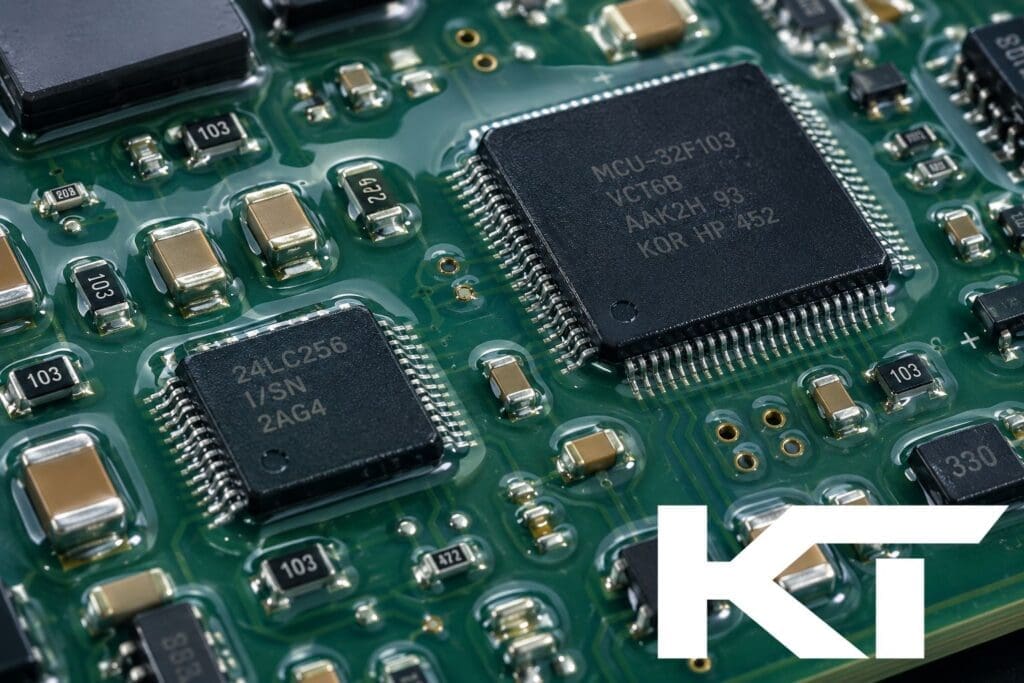
After that comes protection. A properly applied conformal coating service is essential, not optional. Coverage has to be complete, with no thin spots, no skips around tall components and no contamination of areas that need to remain coating-free, such as connectors and test points. We have seen plenty of boards where the coating was applied as a tick-box exercise and the early field failures showed up exactly where the coating thinned out.
For a deeper look at how the process works and which coating types suit which environments, we covered it in detail in our piece on how conformal coating protects electronics.
Subsea is a different problem again. At depth, pressure does things to an assembly that it never sees on a workbench. Air pockets inside enclosures collapse. Cable glands that were watertight at sea level start to weep. Components that were perfectly fine in a vessel-mounted control unit fail within months when the same circuit is deployed at depth.
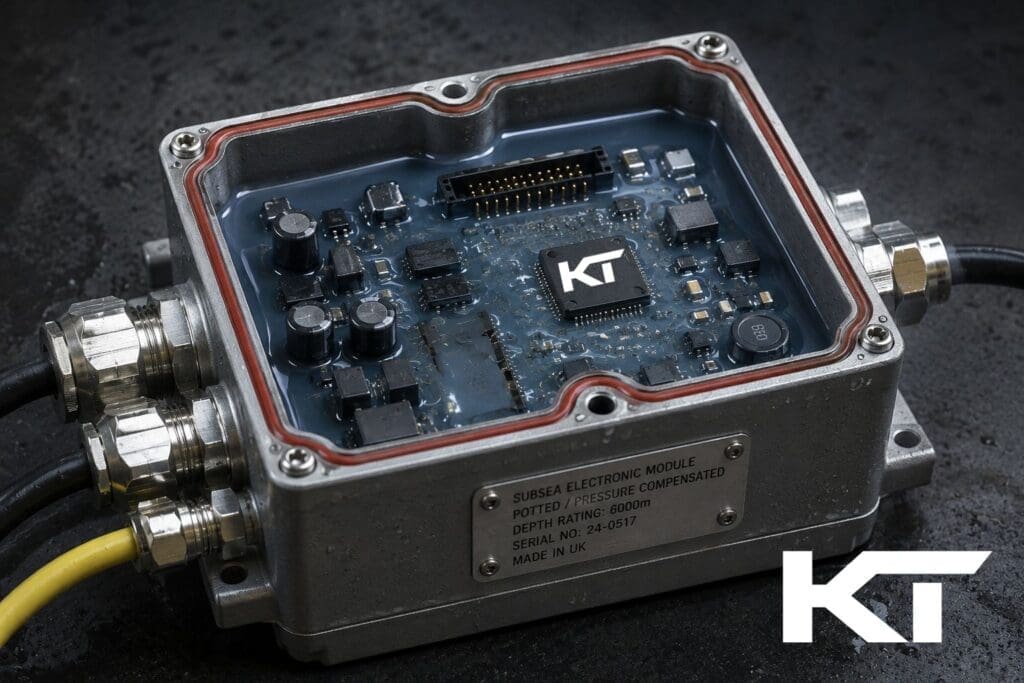
Potting and encapsulation are the standard answers. By filling the assembly with a resin that excludes air and supports the components mechanically, the whole unit becomes a solid block that has nothing to compress. The trick is choosing the right material for the depth, the operating temperature range and the expected service life, and applying it without trapping voids that defeat the purpose.
Cable terminations are the other classic failure point. A weak gland or a poorly strain-relieved cable will fail before the electronics ever get a chance. Mechanical assembly on subsea work needs the same level of care as the soldering. One without the other is not a finished product.
Marine vessels vibrate. Constantly. Engines, props, hull slap, machinery, weather. Subsea installations sit in currents that move them subtly but endlessly. None of that is dramatic on any given day, but over months and years it works on every connection in the assembly.
Through-hole technology has a real place here. Surface mount has its uses, of course, but for connectors, transformers and any large or heavy component that will be subject to ongoing vibration, a through-hole joint with a properly clinched lead is far more resilient than an SMT pad alone. Mechanical fastening of larger components, proper strain relief on cables, and conformal coating that genuinely locks down loose ends all play a part.
This is not glamorous engineering. It is the kind of work that does not show up in marketing brochures. But it is what separates an assembly that lasts twelve years from one that fails at eighteen months.
Marine and offshore electronics are rarely in climate-controlled rooms. A control board on the deck of a North Sea vessel might see negative ten in February and forty plus inside an enclosure baked by July sun. Subsea installations sit at consistently low temperatures, but the swing when they come up for service is just as punishing.
Component derating matters more than people realise. A capacitor that is rated for 85 degrees and is being used at 80 will have a much shorter life than one rated for 105 and used at the same 80. Designing in margin costs more on the BOM, but it is the difference between a board that performs across its full expected service life and one that fails when the seasons change.
And then there is chemical exposure. Hydraulic fluids, fuels, cleaning products, drilling muds, salt fog. Any of these can attack uncoated or poorly coated electronics. The marine sector overlaps heavily with oil and gas electronics manufacturing, and many of the same protection techniques apply across both.
If a marine or subsea assembly fails in service, recovering it is expensive. Sending a diver, dropping an ROV, taking a vessel out of commission. The economics of in-field repair make the case for doing inspection and test properly in the factory before anything ships.
We work to the IPC-A-610 acceptability standard, which sets the visual criteria for what a good solder joint, a properly cleaned board and a complete conformal coating actually look like. For marine work we apply that with additional inspection passes at the points where failures typically start: around connectors, under tall components, along the edges of conformal coated areas, and at any cable termination.
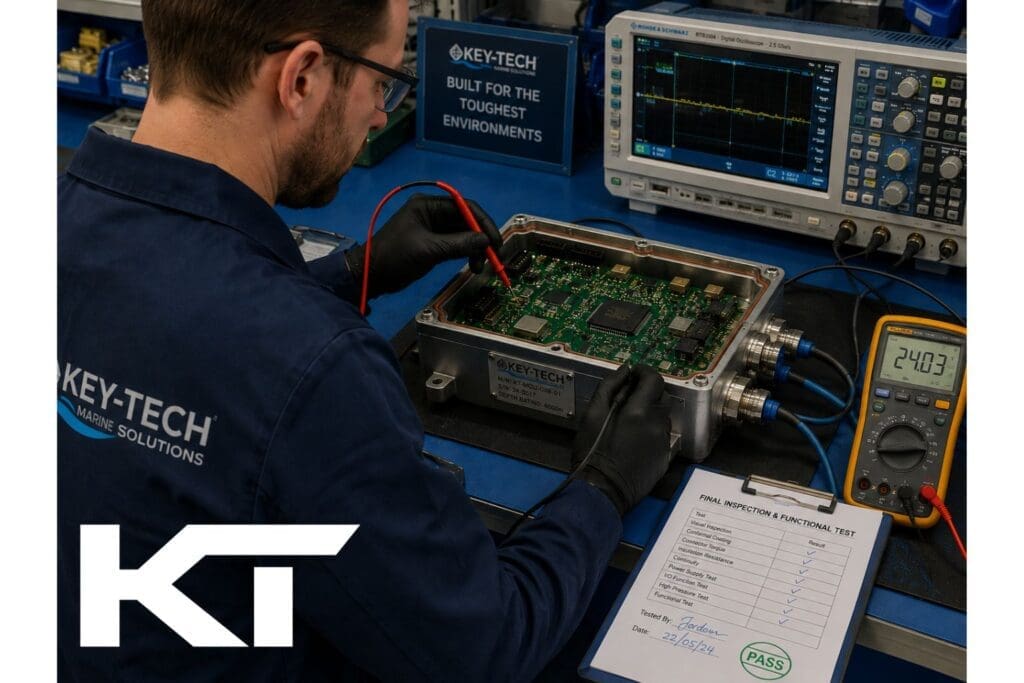
Functional testing is the other half. Continuity, insulation resistance, and end-to-end functional test against customer-defined acceptance criteria. For subsea work, pressure testing of sealed enclosures is often added. The detail of what each test catches is covered on our inspection and test process page, but the principle is simple. Every assembly leaves the factory having proven that it works.
A marine or subsea control system is rarely just a board. It is a board, in a housing, with cables, connectors, glands, mounting hardware, and often a display or interface. Building the PCB well is the start. Getting it into a finished, sealed, tested system is the rest of the work.
Our box build assembly service handles that final stage, integrating PCBs into enclosures, routing and terminating cables, applying labelling, and carrying out the final test of the complete unit. For marine and subsea customers this matters because the failure modes change once you move from a bare board to a complete system. Mechanical fit, sealing integrity, cable routing, even thermal flow inside the enclosure all become things that have to be right.
Some of our marine customers have been with us for more than a decade. That kind of continuity is not the result of one well-built batch. It is the result of consistent traceability, kept records, repeatable processes and the willingness to do the unglamorous things properly every time.
Component obsolescence is a real issue in this sector. A subsea platform might be in service for fifteen or twenty years. Parts that were standard when the design was first manufactured will go end-of-life long before the product does. A manufacturing partner that can flag those issues early, keep good documentation, and support drop-in replacements years down the line is doing something genuinely valuable.
That is what marine and subsea electronics manufacturing actually involves. Not magic. Not foreign processes. Just the discipline to do the right things, in the right order, every single time, with the knowledge of what fails and why.
If you are designing or sourcing electronics for marine, subsea or offshore use, we would be happy to talk about how we approach it. Get in touch with our team and we will give you a straight answer on whether we are the right fit for the work.