A circuit board can look perfect and still fail. For example, a solder joint hidden under a chip might have a crack in it. One resistor might carry the wrong value, or a part might sit the wrong way round. None of that is obvious to the naked eye. That is why PCB inspection and test sits at the heart of every good build.
It is also one of the least understood parts of electronics manufacturing. Buyers often see “AOI and functional test” on a quote and move straight on. Yet the way a manufacturer checks your boards has a direct effect on how many fail in the field.
In this post we explain the main PCB inspection methods in plain terms. We cover what each one finds, what it misses and how testing proves a board actually works. We also share the questions worth asking any contract electronics manufacturer about quality.
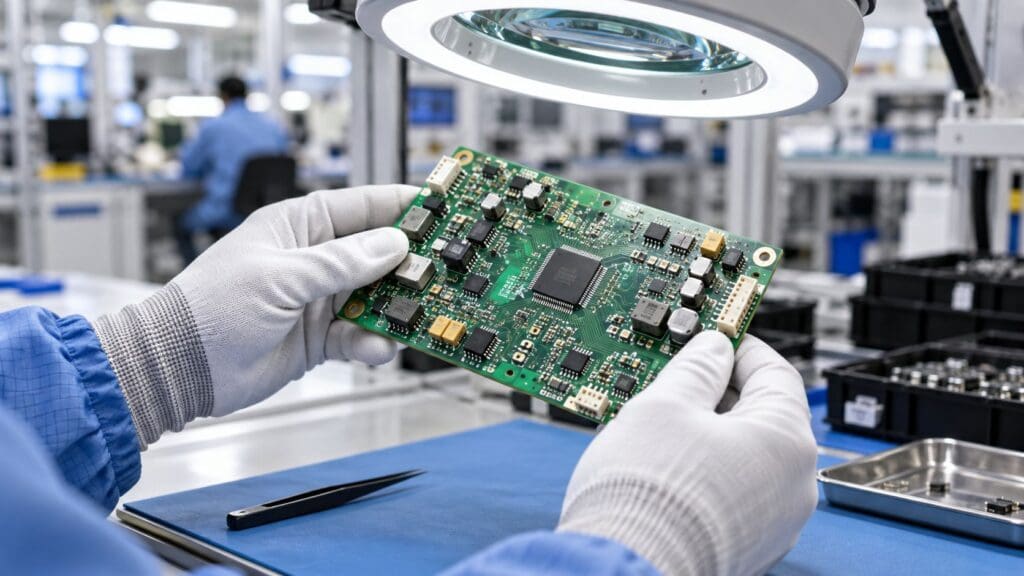
Faults get more expensive the further they travel. A misplaced part found on the line takes a few minutes to fix. However, the same fault found by your customer costs a return, a repair and a little of your reputation.
Good PCB inspection and test is about finding problems as early as possible. It is not one check at the end of the line. Instead, it is a series of checks, and each one targets a different type of fault.
Good inspection also gives you evidence. In regulated sectors such as Medical & Healthcare and defence, you need records that prove every unit passed its checks. A clear PCB inspection and test process gives you that paper trail as standard.
Inspection confirms that your manufacturer built the board correctly. Most manufacturers use a mix of methods at different stages of the build. These are the ones you are most likely to come across.
Quality starts before assembly does. Incoming inspection checks components as they arrive, looking at part numbers, packaging and any signs of damage. It is also a key defence against counterfeit parts. We touched on that risk in our look at the electronics supply chain.
Most solder defects begin at the printing stage. Solder paste inspection measures the paste on each pad before the machines place any parts. Too much paste can cause bridges. On the other hand, too little can leave weak joints. Catching it here is far cheaper than reworking it later.
AOI uses high-resolution cameras to compare each board against a known good reference. It looks for missing parts, wrong orientation, poor alignment and solder faults. It is fast and consistent, so every board on a surface mount line gets the same level of scrutiny. Running AOI before and after reflow catches placement errors while there is still time to fix them.
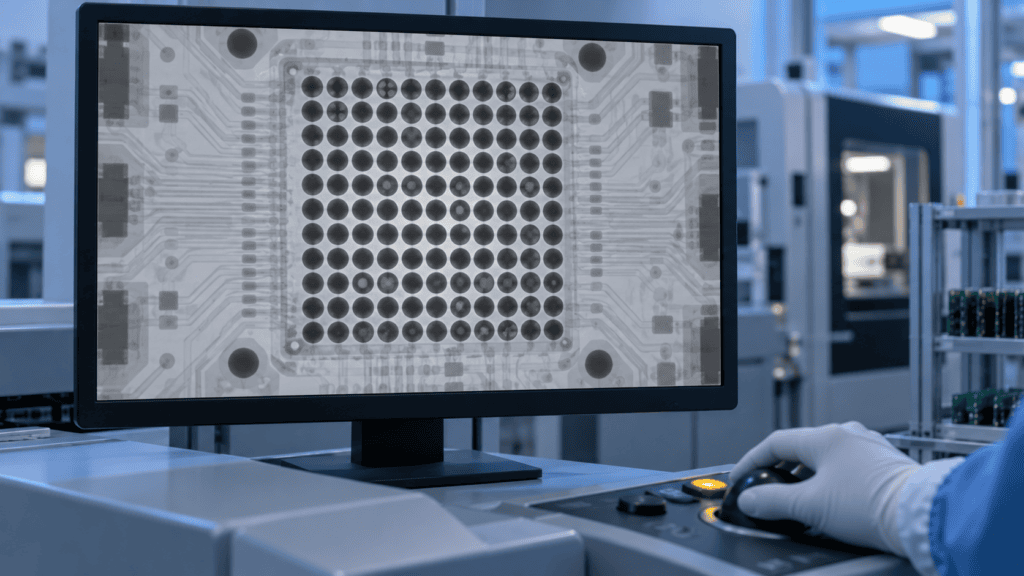
However, cameras simply cannot see some joints. Ball grid arrays (BGAs) and similar packages hide their connections underneath the part. X-ray inspection looks straight through the component to check for voids, bridges and missing balls. For dense, high-reliability boards, it is essential.
Machines are good, but trained eyes still matter. Skilled inspectors check the things automated systems can struggle with, such as through-hole joints, cable dressing and mechanical fit. They also review anything the machines flag and make the final call.
In short, inspection tells you the build is correct. Testing tells you it works. Both matter, and one cannot replace the other.
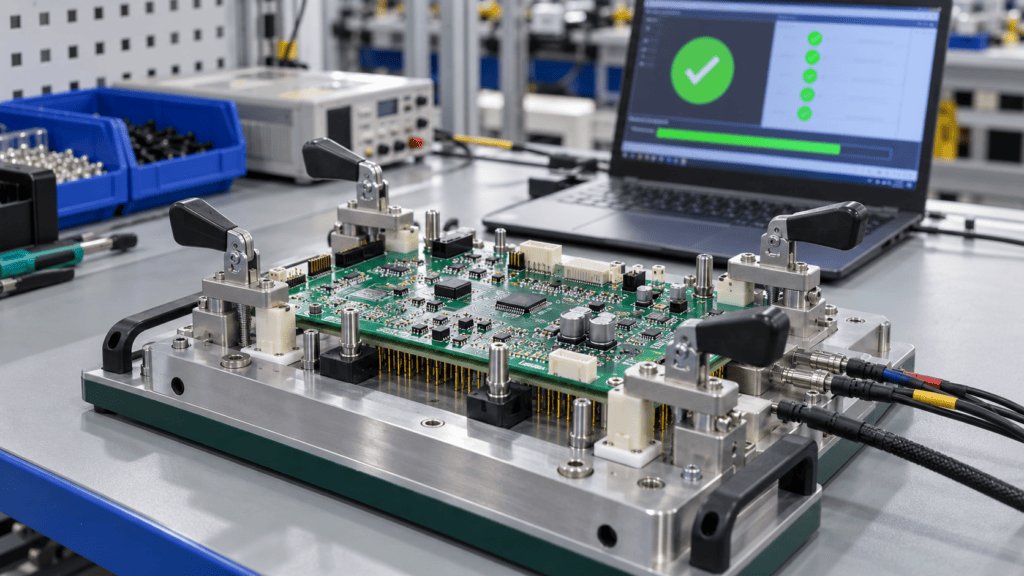
In-circuit testing uses a fixture of probes that touch test points on the board. It checks individual components for the right values and looks for shorts and open circuits. It is quick and precise. As a result, it is a good fit for higher volumes.
Functional testing powers the board up and checks that it does its job. That might be a simple power-on check. It might be a full automated sequence that exercises every circuit. Most manufacturers build each test around a custom fixture and your own specification. If the board is going into a box build, we can also test the finished unit as a whole.
Some faults only show up under stress. Burn-in runs boards at raised temperature and voltage to bring out early failures before they ship. Environmental testing checks performance across temperature, humidity or vibration. For this reason, both are common for products heading into harsh settings, such as marine and subsea equipment.
Testing works best when you plan it in from the start. Test points need to be easy to reach, and the test approach should suit the design. This is one of the things our free design for manufacture review looks at during NPI and prototyping.
Most manufacturers inspect to IPC-A-610. This is the industry standard that sets out what an acceptable electronic assembly looks like. You can find out more about the standard on the IPC website.
The standard splits products into three classes:
The higher the class, the tighter the criteria. It is worth agreeing the class with your manufacturer at quote stage. As a result, everyone inspects to the same standard from day one.
When you compare manufacturers, it pays to dig into how they check your boards. These questions are a good place to start.
Our guide to choosing a PCB assembly partner covers more questions like these.
Fife sits right in the middle of the country, within easy reach of Edinburgh, Glasgow, Dundee and Aberdeen. We also work with customers right across the UK. Wherever you are, you are never far from a real conversation with the people building your product.
At Key-Tech, we believe quality is built in, not inspected in. PCB inspection and test is how we prove it. We check every assembly at several stages, from incoming parts to final test, before it leaves our facility in Kirkcaldy, Fife.
Our process covers solder paste inspection, AOI before and after reflow, and X-ray for hidden joints. Our test engineers write custom test procedures and build fixtures for each product. We also offer in-circuit testing, burn-in and environmental testing where a product needs it.
All inspection is carried out to IPC-A-610, and our operators are trained and certified to J-STD-001. We are certified to ISO 9001 and ISO 13485, and we are JOSCAR registered. In addition, you get full traceability on every unit. See the details on our quality page, or read more about our inspection and test capability.
Want to know how we would inspect and test your product? We would be glad to talk it through. Upload your BOM using the button at the top of the page, or get in touch with the team.